The opening sentence
The agent proposes.
Policy authorizes.
Infrastructure enforces.
A software factory for agent-written change. Quality is decided by loops. Safety is decided by boundaries. Neither is left to the working agent’s judgment.
Agents are untrusted. Everything they read is untrusted. That is the first fact of a software factory, and the last one it is allowed to forget. The working agent may propose a plan, a patch, a merge. It may not grant itself scope, open the network, or declare the work done.
Software Factory — a neutral
working name, package scope
@factory — turns a prompt, a ticket, or a
specification into tested change on an existing codebase. It
is assembled from agents and harnesses, models, skills, tools,
and versioned profiles. Each agent works under a profile:
skills, tools, context, sandbox. The profile is a ceiling. The
task may only narrow it.
Decisions are front-loaded so agents execute well-specified contracts. Governance lives in a catalog of agents, services, and scorecards. Autonomy is earned with evidence, not asserted in a prompt.

Three verbs, in that order
Propose, authorize, enforce
Two control layers exist. Inside the loop, the agent reasons. Outside the loop, runtime enforces. This factory is about the outside.
- Proposes The agent may ask for a plan, a path, a merge.
- Authorizes Policy — versioned files, not another model — decides.
- Enforces Infrastructure the agent cannot reach holds the line.
Planner output is a request, never a grant. If an enforcement point is down, the agent does not start. High-impact actions need an approval the agent cannot give. The factory does not change underneath a run.
Plate II
The two loops
One loop makes a change true. The other makes the factory, and the running system, better. They share evidence. They do not share authority.
Inner loop
Until it passes
Inputs enter. Design sets the limits. The factory assembles a profile and a sandbox. Build happens inside that sandbox. Verify reads the evidence. If it fails, the loop repeats. The agent does not get a longer leash because it is taking longer.
- Inputs
- Design — sets limits
- Assemble
- Build, in the sandbox
- Verify
Outer loop
After it ships
Review, then deploy under an approval policy, then production signals that return to design. The same loop improves the factory: skills, tools, models, workflows. A signal is a new WorkItem. It is not a new permission.
- Review
- Deploy, under approval
- Production signals
- Back to design
- Factory improvement

Plate III
Four boundaries
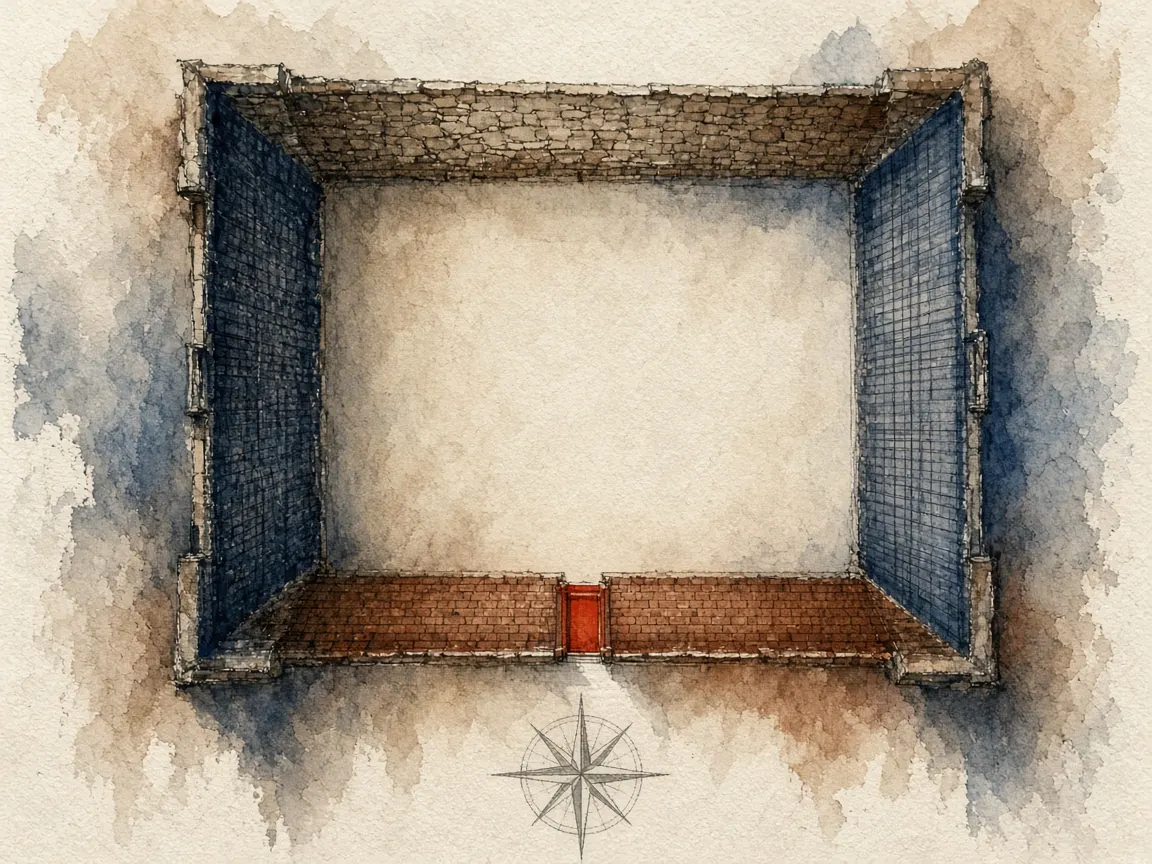
An agent needs room to reason. Four walls decide what it can actually do, whether it cooperates or not.
01 · Sandbox
Where the work runs
Per task, destroyed after, isolation tested. The builder does not inherit yesterday’s files, credentials, or network.
02 · Network
What it can reach
Default-deny egress, operation by operation. Inference goes through a model gateway with budgets. The agent does not hold the proxy.
03 · Supply chain
What it may use
Approved components only, through an admission point. Provenance and an SBOM on outputs. Credentials stripped from inputs.
04 · Identity & access
Who it acts as
Each agent has its own identity. The profile is the maximum. Delegation only narrows. Credentials stay at the proxy. A runtime authorization service decides.
How much the factory takes on
L1, L2, L3
The boundaries stay the same at every level. What grows is the share of supervision that infrastructure takes over from people.
L1
Human-orchestrated
A person chooses the next step and reviews what the agent produces. Useful for risky work, and as a floor the factory can fall back to.
L2
Workflow-orchestrated
A durable workflow chooses the next step. Fresh sandbox per run. Shared service, not a laptop session. This is where we work now.
L3
Agent-orchestrated
An orchestrator agent proposes the next step and a monitoring agent may flag, not grant. A dark factory auto-approves only bounded classes as evidence accrues. A person stays accountable. Later.
Plate IV · Interactive
Eight gated stages
Each stage has an entry gate. A stage cannot self-approve. Select a station, or light one of the two loops.
Inner loop · stages 01–06
Outer loop · stages 07–08, signals return
How to read the plate: vermilion is the inner loop; blue is the outer. Arrow keys move the station. A highlighted loop dims the stages that do not belong to it.
Plate V
Per-run evidence
Every run writes a tamper-evident record, linked by run ID. If the log cannot be written, the run fails closed.
The factory supplies facts a person can stand at a whiteboard and use: which agent, for whom, under which profile, with which components, which checks passed. That is provenance, not storytelling.
- Run run_id, agent, model, cost, duration, retries, verdicts.
- Bundle Tests, review verdicts, SBOM, attestation hash, policy version.
- Decision The question, the options, who chose, under which policy.
- WorkItem Spec, acceptance tests, risk, Definition-of-Ready, open questions.

Earned, not granted
Autonomy is a ladder
Promotion and demotion come from metrics on the evidence, per repository and per task class. A clean run is a fact. It is not a personality.
Observe. The agent may look. It does not write.
Pull request only, small by policy, a person approves. The starting rung for unproven work.
Auto-merge for low-risk classes after a recorded streak of clean runs. Thresholds are policy, not folklore.
Later. Bounded classes only, as evidence accrues. A kill switch remains: cancel the run, revoke tokens, revert the change.
Plate VI · The ledger
The measurement layer
Every metric is computed from per-run evidence bundles. There is no second telemetry path, and no borrowed score the factory cannot show its working for.
The shape of this layer is inspired by public engineering-intelligence practice: delivery measures in the DORA family, run-level operational telemetry, autonomy as a recorded state, and — if a team chooses — developer-experience surveys. Nothing here names a vendor as a partner. Live figures belong to the factory that produced the bundles.
Delivery, in the DORA manner
Deployment frequency, lead time for change, change-failure rate, and time to restore. Each one is rolled up from release and operate records already in the bundle: when the gate opened, whether the change had to come back, how long the rollback took.
Agent runs
- Ready-check Share of WorkItems that pass Definition-of-Ready on first presentation.
- First-pass gate Share of runs that clear verify without a retry.
- Review rejection Share of reviews that return findings the builder must resolve.
- Escaped defects Faults found after merge, joined to the run that shipped them.
- Cost & time Spend and duration per merged pull request, from the run record.
- Human time Steward hours recorded against the same run — saved only when the evidence says so.
Autonomy as a measured state
Level is stored per tenant and per agent, and it moves only when earned-autonomy thresholds in policy are met or missed. A tenant does not inherit an agent’s streak. An agent does not inherit a tenant’s optimism.
Optional surveys
Developer-experience surveys may sit beside the ledger. They are optional, dated, and never a substitute for a missing bundle. A feeling is not a verify gate.
The scorecard
A scorecard is a set of rules over Services and Agents. Every cell names the bundle field it reads. Fail closed if that field is absent.
| Rule | Bundle field | Reads as |
|---|---|---|
| Tests present | EvidenceBundle.tests | Held-out and first-party results recorded |
| CI green | Run.verdicts | Hard-mandatory gates passed |
| Owner set | WorkItem / Service catalog | A named accountable person |
| No secrets in context | EvidenceBundle.scans | Secret scan clean for the run |
| Licence clean | EvidenceBundle.sbom | Admitted components only |
| Autonomy in range | Agent.autonomy + policy threshold | Level matches earned evidence |
| Scope | Subject | Level | Moves when |
|---|---|---|---|
| Per tenant | The accountable workspace | Policy ceiling | Aggregate clean-run streak across its agents |
| Per agent | A single identity + profile | Earned rung | That agent’s own first-pass, rejection, and escape rates |

Waitlist
Join the waitlist
Name and email only. Sign up and log in are not open yet — they lead here until accounts exist.